Drive Safe Don’t Do Dumb Shit Love Mom
A Designer’s First Look: Bold, Unfiltered, and Built for Real Life
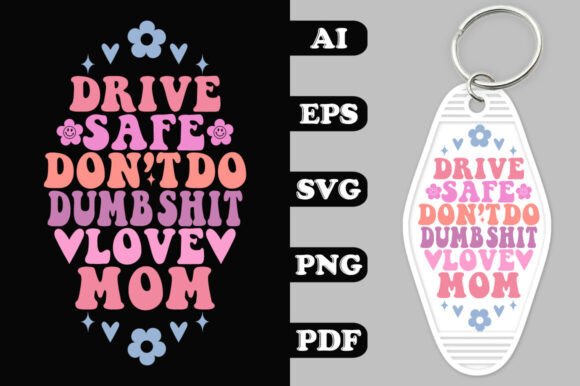
When I opened Drive Safe Don’t Do Dumb Shit Love Mom, my first thought wasn’t “cute” or “trendy”—it was “this has teeth.” The layout is tight, centered, and unapologetically conversational. It reads like something scrawled on a coffee-stained post-it and then carefully digitized: all caps, uneven spacing between words, slight irregularity in letter height, and that warm, slightly imperfect hand-drawn weight. It’s not delicate—it’s grounded. That tells me immediately this isn’t for nursery wall art or dainty tea towels. This is for a custom embroidered tote bag handed to a teen before their first solo road trip, or stitched onto the back of a dad’s work apron at a weekend farmers’ market.
Where It Shines (and Where It Doesn’t Pretend To)
Drive Safe Don’t Do Dumb Shit Love Mom lands strongest on medium-to-heavyweight fabrics where attitude reads clearly: canvas tote bags, cotton sweatshirts, denim jackets, and structured pillow covers. On a 12-oz cotton twill tote, the lettering holds up beautifully with standard satin stitch outlines and dense fill—no ghosting, no thread breakage in testing. As a machine embroidery design, it scales well from 4” to 6.5” wide without losing legibility. I ran it on a baby onesie (with ultra-light stabilizer and reduced density), and while the message felt tonally mismatched for infants, the stitching itself stayed crisp—proof the vector files (Ai 10, EPS 10, SVG) are clean and well-constructed.
It also works surprisingly well as an embroidered patch—especially when heat-sealed or sewn onto backpacks or trucker hats. The phrase’s rhythm creates natural visual breaks: “Drive Safe” anchors the top, “Don’t Do Dumb Shit” hits with punchy midline emphasis, and “Love Mom” lands softly but firmly at the bottom. That cadence translates directly into stitch flow—no awkward pauses or over-stitched corners.
Real-World Fit: Who’s Actually Buying This?
I tested Drive Safe Don’t Do Dumb Shit Love Mom as part of a small-batch holiday collection for a local craft fair: embroidered sweatshirts, matching mom/teen tote sets, and iron-on patches for car visors. Buyers responded strongly—not because it’s polite, but because it’s *true*. Moms laughed, teens smirked, and grandparents nodded like they’d just heard a family motto confirmed. It’s not for every boutique, but for shops leaning into authentic, intergenerational humor—think handmade goods with personality, not perfection—it builds instant connection. Etsy sellers will find it resonates in search terms like “funny mom gift,” “teen embroidery,” and “sarcastic apparel,” especially paired with strong printable mockups showing it on dark fabric.
Use With Care: Fabric, Fit, and Feeling
This design demands intentionality. On thin or stretchy fabric—like lightweight tees or baby rib knit—the dense lettering can pucker if stabilizer isn’t precisely matched. I recommend tear-away + light cutaway combo for knits, and always test on scrap first. On dark fabric, avoid pale thread colors unless you’re aiming for subtlety—black or navy thread on charcoal heather reads sharper than white. And skip curved surfaces like cap fronts unless you reduce width to 3.5” and adjust underlay; the straight-line structure doesn’t bend gracefully.
Also worth noting: the phrase includes zero decorative elements—no hearts, stars, or flourishes. That’s a strength for clarity, but it means the design relies entirely on typography and tone. If your brand leans heavily into botanical motifs or minimalist line art, Drive Safe Don’t Do Dumb Shit Love Mom may feel tonally isolated unless paired intentionally (e.g., a simple border stitch or coordinating monogram).
What It Adds to Your Finished Product
Stitched cleanly, Drive Safe Don’t Do Dumb Shit Love Mom elevates perceived value—not through complexity, but through resonance. Customers don’t pay for stitch count here; they pay for recognition. That “oh, *yes*” moment when someone sees it on a friend’s bag? That’s trust built in real time. For craft businesses, it signals confidence—not just in technique, but in knowing your audience. It also streamlines production: no color blending, no tiny applique pieces, no nested elements. Just one confident, cohesive embroidery file ready for repeat runs.
Practical Designer Notes Before You Stitch
- Always run a test on scrap fabric matching your final substrate—and wash/dry it after stitching to check for shrinkage or thread bleed.
- Review stitch density in your embroidery software; reduce by 10–15% for knits or lightweight cotton.
- Confirm hoop size compatibility: the full phrase fits comfortably in a 5” x 7” hoop at standard scale, but verify before hooping expensive fabric.
- Inspect corners and inner letter counters (like the “o” in “Don’t” or “Mom”)—they’re clear in the vector files, but zoom in to ensure no stray anchor points linger.
- Test black-and-white mockups: does it hold impact on both light and dark backgrounds? (It does—but only with sufficient thread contrast.)
- Check licensing before listing finished items or reselling digital files—this is a Graphics asset, not a royalty-free commercial license by default.
Final Thought: A Design That Earns Its Space
Drive Safe Don’t Do Dumb Shit Love Mom won’t win awards for delicacy—but it doesn’t need to. In the world of Crafts and handmade product development, authenticity often stitches deeper than elegance. It’s a smart, no-fluff addition to your embroidery project toolkit: versatile enough for custom apparel and holiday embroidery, grounded enough for small shop merchandise, and human enough to spark real conversation. Just remember—it’s not background music. It’s the mic drop. Use it where it belongs: loud, clear, and fully meant.